Author: Prof. Engr. Zamir Ahmed Awan, Sinologist – Diplomat – Advisor - Consultant,Founding Chair, Global Silk Route research Alliance.(E-mail: awanzamir@yahoo.com).
Seventy years of scientific ambition have transformed China from a newcomer in rocketry into a major force in satellite navigation, space exploration and the emerging commercial space economy.
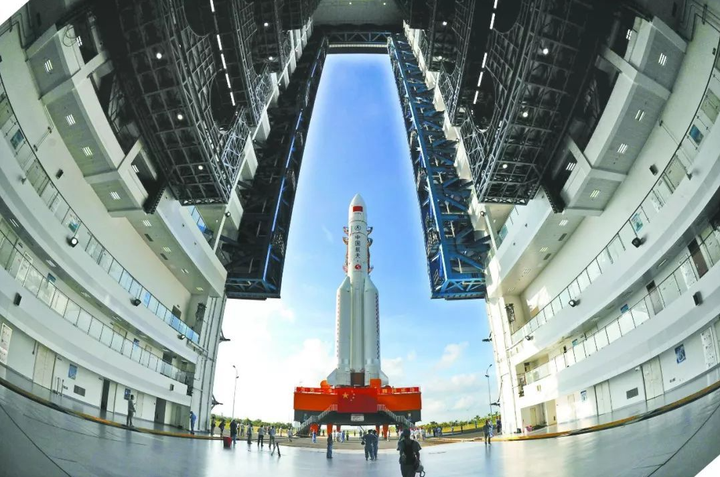
On October 8, 1956, China established the Fifth Academy of the Ministry of National Defense, laying the institutional foundation for its space programme. Seventy years later, the country stands among the world's leading space powers, with achievements spanning satellite navigation, human spaceflight, lunar exploration, Mars missions and an independently constructed space station.
This transformation reflects more than technological progress. It demonstrates how sustained investment in science, engineering, education and industrial capacity can reshape a nation's development trajectory.
From one satellite to deep space
China's journey reached an early milestone in 1970, when Dongfanghong-1, the country's first satellite, entered orbit. Since then, the programme has steadily expanded its ambitions. The BeiDou Navigation Satellite System provides positioning, navigation and timing services; the Chang'e programme has advanced lunar exploration; and Tianwen-1 successfully reached Mars and deployed the Zhurong rover.
The Tiangong space station, completed in 2022, represents another major achievement. It provides a platform for scientific experiments, technology testing and sustained human activity in orbit. China's crewed missions have also developed the capabilities required for long-duration spaceflight, orbital construction and life-support systems.
The next major goal is a crewed lunar landing before 2030. Achieving it would mark another historic step and expand opportunities for lunar science, engineering and international research. Meanwhile, private launch companies such as LandSpace, i-Space, Galactic Energy, Space Pioneer and Orienspace are helping create a more dynamic commercial space sector.
China's experience shows what long-term planning, technical learning and the gradual development of domestic capabilities can achieve.
How many objects has China launched? A global comparison
China's progress is also visible in the scale of its space activity. Data compiled from the United Nations Office for Outer Space Affairs (UNOOSA), published through Our World in Data, recorded the following cumulative totals through 2025.
Country or group Objects launched into space
United States 15,677
Russia 3,914
China 1,759
Rest of the world, approximately 3,515
Global total 24,865
The figures include satellites, probes, landers, crewed spacecraft and space-station elements—not satellites alone. They also reflect the dataset's rules for attributing launches, so the country figures should be treated as a broad comparison rather than a precise count of satellites currently operating in orbit.
The numbers put China's achievement in perspective. Although its cumulative total remains below those of the United States and Russia, its space activity has expanded rapidly. In 2025, China conducted 50 commercial space launches, and 311 commercial satellites were placed into orbit, representing 84 percent of all Chinese satellites launched that year, according to China's space authorities.
Space technology as an engine of economic development
The value of a space programme cannot be measured by launches alone. Its influence reaches transport, agriculture, telecommunications, disaster management, scientific research and manufacturing.
China's BeiDou satellite navigation system illustrates this connection. In 2024, China's satellite navigation and positioning service industry generated an estimated 575.8 billion yuan in output, up 7.39 percent from the previous year. Its applications support vehicle navigation, precision farming, logistics, infrastructure and location-based services. BeiDou products and services have also reached more than 140 countries and regions.
Earth-observation satellites help monitor crops, forests, water resources and environmental change. Satellite communications extend connectivity to remote areas, while space-based data supports weather forecasting, disaster response and infrastructure planning. These applications can improve productivity, reduce certain operating costs and help public authorities make better-informed decisions.
Space research also strengthens industrial capabilities. Developing rockets, spacecraft, sensors, advanced materials and onboard computers creates demand for skilled engineers and researchers, encourages investment in research and development, and supports the growth of domestic supply chains. China's expanding commercial sector adds opportunities for private businesses in launch services, satellite manufacturing, data analysis and communications.
Contributions beyond China's borders
Space is a shared domain, and its benefits are greatest when knowledge and services are widely accessible. BeiDou provides global positioning, navigation and timing services, while Chinese Earth-observation data and satellite applications can support agriculture, disaster preparedness and infrastructure development abroad.
China has also offered international research opportunities linked to its lunar exploration programme. Lunar samples returned by the Chang'e missions have opened new avenues for scientific study, and China's plans for future lunar missions include opportunities for international participation.
Such cooperation can help developing countries address practical challenges without having to build every element of a space programme independently. For countries such as Pakistan, opportunities include satellite data for flood monitoring, agricultural planning, water management and disaster response, alongside education and technical cooperation.
The next frontier
China's achievements do not mean that its work is finished. Crewed lunar exploration, Mars sample return, reusable launch vehicles and commercial satellite networks will demand further advances in engineering, reliability and scientific research. The growing number of satellites also makes responsible orbital management, debris reduction and international coordination increasingly important.
Seventy years ago, China's space programme began with a modest institutional foundation. Today, it is a major contributor to space exploration and a growing source of technologies with practical economic value. Its lasting significance will depend not only on reaching new destinations, but also on translating scientific achievement into better services, new knowledge and opportunities for people in China and around the world.
(ASIA PACIFIC DAILY)