Author: Prof. Engr. Zamir Ahmed Awan, Sinologist – Diplomat – Advisor - Consultant,Founding Chair, Global Silk Route research Alliance.(E-mail: awanzamir@yahoo.com).
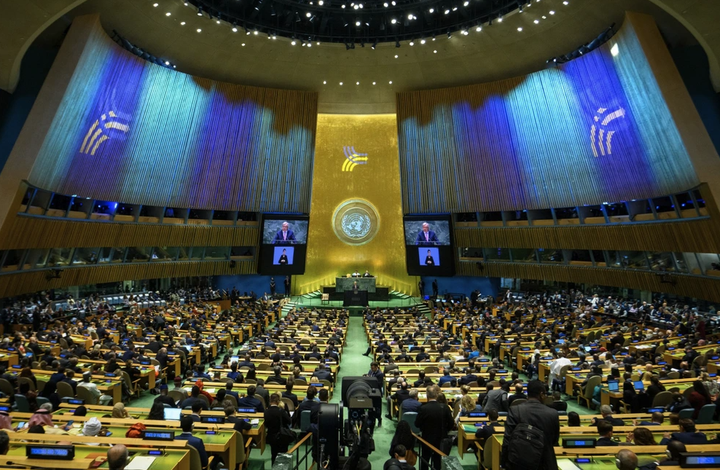
The 81st session of the United Nations General Assembly opens its General Debate on September 22 under a particularly relevant theme: “Restoring trust, managing transformation: a United Nations that delivers for all.” Nearly 130 heads of state and government are expected during High-Level Week. The agenda will encompass peace and security, sustainable development, climate change, health, AI governance, nuclear risks and the future of multilateralism.
But behind the formal agenda lies a deeper question: can the UN still deliver justice when geopolitical power repeatedly overrides collective decisions? The organisation was created to uphold sovereign equality, prevent war and provide mechanisms for peaceful dispute settlement. Yet the credibility of that system is increasingly tested when Security Council divisions prevent decisive action.
Kashmir illustrates the problem from Pakistan’s perspective. Security Council Resolution 47 of 1948 established a framework for restoring peace and envisaged a plebiscite in Jammu and Kashmir. Decades later, the dispute remains unresolved. Palestine presents another example. Resolution 2334, adopted in 2016 by 14 votes with the United States abstaining, declared Israeli settlements in occupied Palestinian territory to have no legal validity and demanded an end to settlement activity. UN reporting in 2026, however, recorded continued settlement activity and thousands of housing units being advanced or approved.
Gaza has exposed the limitations of the Security Council even more dramatically. In June 2025, the United States vetoed a permanent-ceasefire resolution despite all 14 other Council members voting in favour. A similar US veto blocked a Gaza ceasefire resolution in September 2025. Washington has consistently argued that its approach reflects Israel’s security concerns and the need to secure hostage releases, while critics argue that repeated diplomatic protection has weakened international pressure for ending the conflict. The debate is therefore not simply about one country’s policy; it is about whether the veto can coexist with effective collective security.
Ukraine demonstrates that the problem is broader than the Middle East. In February 2022, Russia vetoed a Security Council resolution demanding an end to its military offensive against Ukraine; the General Assembly subsequently adopted a resolution demanding Russia end its use of force and withdraw its troops. The continuing conflict demonstrates the gap between international resolutions and their practical enforcement.
The same institutional weakness becomes particularly serious when major powers are directly involved in conflicts. The UN system can condemn, debate, investigate and recommend, but enforcement ultimately depends heavily on political cooperation. This creates an uncomfortable perception that international law is applied differently according to geopolitical influence. That perception, whether fully justified in every case or not, damages confidence in multilateral institutions.
The 81st General Debate should therefore become more than another exchange of national statements. Its central challenge should be implementation. UN members could advance discussions on restricting the circumstances in which the veto is used in situations involving mass atrocities, improving mechanisms for implementing binding Security Council decisions, strengthening international judicial institutions, and making sanctions and accountability mechanisms more consistent and transparent. Such reforms would require broad agreement and cannot realistically eliminate great-power politics overnight.
China has increasingly argued for precisely this return to the UN Charter. Beijing says sovereign equality, non-interference, peaceful settlement of disputes and opposition to unilateral coercion should remain fundamental principles of international relations. In a 2026 Security Council debate, China argued that countries, regardless of their size or strength, should enjoy equal rights and that disputes should be addressed through dialogue rather than force.
China has also attempted to translate this approach into diplomatic initiatives. Its Global Security Initiative (GSI) advocates common, comprehensive, cooperative and sustainable security and emphasizes dialogue and consultation. Beijing facilitated the 2023 Saudi-Iran rapprochement and has promoted political dialogue on Ukraine, Palestine and other conflicts. China also describes the UN as the principal platform for global security governance and has called for strengthening, rather than bypassing, the UN-centered international system.
This approach offers an important alternative to a world in which security is defined primarily through military alliances and coercive power. Its credibility, however, will ultimately depend on consistent implementation and on China's willingness, like every major power, to accept meaningful multilateral constraints when its own interests are involved.
The expected outcome of the 81st session is unlikely to be an immediate transformation of the international system. More realistically, it may produce renewed political commitments, resolutions and reform proposals. The real test will come afterward.
The UN does not need to become an institution against powerful countries; it needs to become an institution where power is accountable to rules. If the 81st General Assembly can move the debate from declarations toward implementation, it can begin restoring the trust reflected in its theme. A stronger UN would not diminish great powers; it would give small and large nations alike greater confidence that international law means the same thing for everyone.
(ASIA PACIFIC DAILY)