Author: Prof. Engr. Zamir Ahmed Awan, Founding Chair GSRRA, Sinologist, Diplomat, Editor, Analyst, Advisor, Consultant, Researcher at Global South Economic and Trade Cooperation Research Center, and Non-Resident Fellow of CCG. (E-mail: awanzamir@yahoo.com).
Few symbols better capture China’s modernization and innovation drive than its high-speed railways. From a modest beginning just two decades ago to today’s world-leading network stretching across the vast mainland, China’s high-speed rail (HSR) system has redefined mobility, economic integration, and national pride. It stands as a living testimony to what vision, determination, and technological excellence can achieve when fused under a coherent long-term plan.
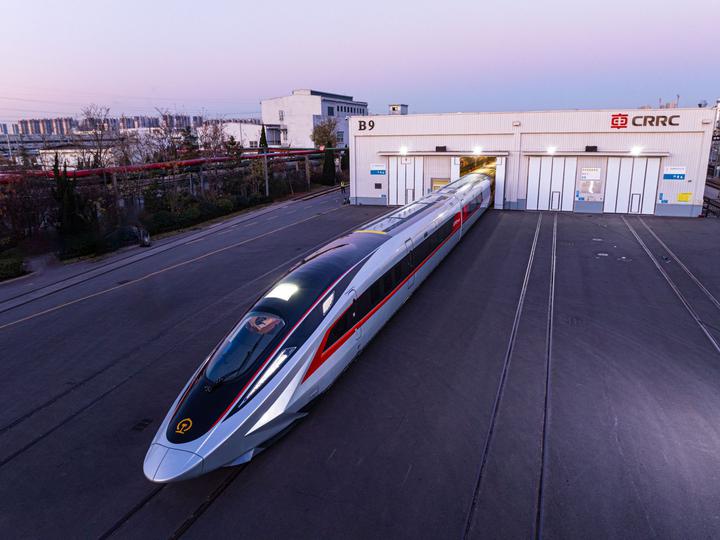
Today, with the launch and successful testing of the next-generation CR450 high-speed train, China is once again setting a new global standard. This cutting-edge train recently achieved a speed of 453 kilometers per hour in pre-service tests — a new record for wheel-on-rail trains anywhere in the world. The CR450 is more than just another technological leap; it represents the culmination of decades of continuous innovation and the confident step of a nation leading global transport transformation.
The History of Rail Development in China
China’s rail journey began in the late 19th century under colonial and semi-colonial conditions, when early lines were built by foreign powers for narrow, strategic purposes. The modern era of rail development, however, took shape after 1949 when the People’s Republic of China began to rebuild and expand the national railway network under state leadership.
For decades, rail remained the backbone of China’s domestic connectivity, transporting people, coal, grain, and goods across vast distances. But by the late 1990s, with rapid urbanization and economic expansion, the conventional rail system was stretched beyond capacity. The need for a faster, more efficient, and environmentally friendly mode of transport became evident.
The early 2000s marked the beginning of a new era. The Chinese government launched an ambitious Medium- and Long-Term Railway Development Plan, which laid the foundation for the high-speed rail system. The first true high-speed line, the Beijing–Tianjin Intercity Railway, opened in 2008, just before the Beijing Olympics, symbolizing a modern China racing into the future.
Building the World’s Largest High-Speed Rail Network
From that historic beginning, China’s high-speed rail has grown with breathtaking speed and scale. As of 2025, the country boasts more than 45,000 kilometers of high-speed rail lines — over two-thirds of the world’s total network. Every major city in China with a population exceeding half a million is now connected to the HSR system, forming a seamless web that integrates regional economies and facilitates mobility for hundreds of millions of passengers annually.
Trains crisscross the nation from Harbin in the northeast to Guangzhou in the south, from Shanghai in the east to Urumqi in the far west. The system has transformed domestic travel, reducing journeys that once took days to mere hours. For example, what used to be a 12-hour trip between Beijing and Shanghai now takes just 4.5 hours on the Fuxing bullet train.
China’s HSR development is guided by principles of safety, speed, reliability, affordability, and sustainability. Every generation of Chinese trains — from the early Harmony (Hexie) models to the current Fuxing and now CR450 — represents a leap in indigenous innovation, design efficiency, and passenger comfort.
Fuxing: The Pride of China’s High-Speed Fleet
Before the arrival of the CR450, China’s Fuxing series (meaning “Rejuvenation”) symbolized the nation’s high-speed success. The Fuxing CR400AF and CR400BF models operate at a commercial speed of 350 kilometers per hour, making them the fastest regularly scheduled trains in the world. These trains are 100% domestically developed — a source of immense national pride — with technological independence in traction, control, and safety systems.
They are not only fast but also energy-efficient and passenger-friendly. The Fuxing trains have set new global standards in reliability, punctuality, and safety, with their on-time performance exceeding 99%. They serve major routes such as Beijing–Shanghai, Beijing–Guangzhou, Shanghai–Shenzhen, and Xi’an–Chengdu, enabling over 10 billion cumulative passenger trips since the start of operations.
The CR450: A New Global Benchmark
In 2021, China launched the CR450 project — its next-generation high-speed train development program — as part of a national initiative to push the boundaries of engineering and innovation. After years of research, design, and rigorous testing, the CR450 has now demonstrated a remarkable achievement: reaching 453 kilometers per hour during tests on the Shanghai–Chongqing–Chengdu high-speed corridor.
The new train’s performance surpasses every other wheel-on-rail train in the world. For context:
France’s TGV and Japan’s Shinkansen both reach commercial speeds of around 320 km/h.
South Korea’s KTX-Sancheon operates at 305 km/h.
China’s Fuxing CR400, already a world leader, has a top speed of 350 km/h.
The CR450 now raises the ceiling further, showing that China’s technological ecosystem — from materials science to digital control systems — continues to advance rapidly.
But the story does not end with speed alone. The CR450 embodies a new design philosophy centered on efficiency, environmental sustainability, and passenger comfort. The train consumes less energy per kilometer than its predecessors, operates with reduced noise and vibration, and integrates advanced smart-control and monitoring systems. Every component, from the aerodynamic nose cone to the braking system, has been optimized through thousands of wind tunnel tests and digital simulations.
Before entering commercial service, the CR450 must complete 600,000 kilometers of safe trial runs — a standard protocol for ensuring reliability and safety in all operating conditions. Commercial operations are expected to begin by 2026, marking yet another milestone in China’s journey toward becoming the undisputed leader in high-speed rail technology.
A Comparative Global Perspective
In less than two decades, China has achieved what took Europe and Japan over half a century to build. The global high-speed rail landscape now looks unmistakably China-centric.
Country Maximum Commercial Speed Length of HSR Network (approx.)
China 350 km/h (CR400) 45,000+ km
France (TGV) 320 km/h 2,800 km
Japan (Shinkansen) 320 km/h 3,000 km
Spain (AVE) 310 km/h 3,200 km
Germany (ICE) 300 km/h 1,700 km
South Korea (KTX) 305 km/h 1,200 km
China’s achievements dwarf those of other nations not only in terms of scale but also integration — linking more than 80% of major cities by high-speed rail, with uniform ticketing systems, synchronized timetables, and consistent safety standards.
While Japan’s Shinkansen pioneered the idea of high-speed travel, and France’s TGV symbolized Western innovation, China’s model represents speed with inclusivity — offering affordability, accessibility, and national reach. Millions of ordinary citizens, not just business travelers, benefit from this modern marvel.
China’s Railways Going Global
China’s expertise in high-speed rail is not confined to its borders. Through the Belt and Road Initiative (BRI), China has become the principal partner in railway construction across Asia, Africa, and Europe. From Indonesia’s Jakarta–Bandung High-Speed Railway, now operational, to projects in Thailand, Laos, Hungary, and Serbia, China is exporting not just trains, but an entire ecosystem of engineering excellence, financing, and operational know-how.
Chinese companies are building or helping to modernize railway systems in Kenya, Ethiopia, Egypt, Nigeria, and Argentina, among others. These projects are more than commercial ventures; they symbolize China’s vision of connectivity, cooperation, and shared development.
Unlike other global players, China offers an unmatched combination of technology, experience, speed, and affordability. Its integrated model — from design and construction to financing and training — ensures projects are delivered efficiently and sustainably.
Why China Leads: Technology, Experience, and Vision
China’s dominance in high-speed rail stems from a unique blend of policy vision, technological prowess, and strategic consistency. Long-term planning has ensured stable funding, coordinated research, and continuous human resource development. The country’s vast domestic market has allowed for large-scale testing and rapid iteration of technology.
Moreover, China’s industrial ecosystem — from steel manufacturing to electrical systems — provides full supply-chain control. This reduces costs and ensures quality, giving China a decisive edge in global competition.
Perhaps most importantly, China views high-speed rail not just as infrastructure, but as a social equalizer — a tool to bridge regional divides, promote tourism, enhance labor mobility, and stimulate balanced regional development.
From the icy plains of Harbin to the highlands of Yunnan, high-speed trains now carry dreams, ideas, and opportunities across the world’s third-largest country.
Riding Toward a Smarter, Greener Future
As the CR450 prepares for commercial service, China’s railway engineers are already looking beyond — to the next frontier of innovation: intelligent railways, autonomous train operation, and green energy integration. Future trains may exceed 500 km/h with maglev technology, while smart rail networks will integrate artificial intelligence to optimize scheduling, safety, and energy use.
High-speed rail is also central to China’s climate strategy. Electrified trains dramatically reduce carbon emissions compared to air and road transport. With growing urbanization and middle-class mobility, rail offers a sustainable model of growth and modernization.
A Symbol of National Confidence and Global Partnership
From the early steam engines of the 19th century to the sleek CR450 of today, China’s rail journey is nothing short of transformative. In less than a generation, the country has built the largest, fastest, and most advanced high-speed railway network in the world — connecting its people, empowering its regions, and inspiring nations worldwide.
The CR450 stands as both a technological marvel and a symbol of China’s confidence in its future. With its unmatched capacity, affordability, and vision for shared progress, China is not just moving people faster — it is driving the world toward a new era of sustainable, connected development.
No other country today can match China’s combination of scale, speed, quality, and affordability. And as China extends its helping hand to friendly nations to build modern railways, it carries with it not only technology and finance but a spirit of partnership and mutual progress.
The world may be divided by borders — but thanks to China’s high-speed railways, it is now more connected than ever before.
(ASIA PACIFIC DAILY)